
The short answer is no. AI will not replace home inspectors. But AI is fundamentally changing how inspectors work, how fast they deliver reports, and what clients expect. The inspectors who understand this shift are pulling ahead. The ones who ignore it are falling behind. Here is what is actually happening on the ground in 2026.
What AI Can Do Today in Home Inspections
AI in home inspections is not science fiction. It is production software that thousands of inspectors already use daily. Here is what the technology handles right now:
Photo Analysis and Auto-Categorization
Modern AI home inspection software can analyze a photo of a roof, electrical panel, or foundation crack and automatically categorize it into the correct building system. You snap a photo of a corroded pipe fitting, and the software places it under "Plumbing" without you touching a dropdown menu. This works across 15 or more building system categories and handles hundreds of common defect types.
Comment Generation from Photos
AI vision models can look at an inspection photo and generate a professional, standards-compliant comment describing what is visible. A photo of a double-tapped breaker produces a comment explaining the defect, why it matters, and what action is recommended. The inspector reviews the output, adjusts if needed, and moves on. What used to take 3 minutes of typing takes 10 seconds of review.
Voice-to-Text with AI Polishing
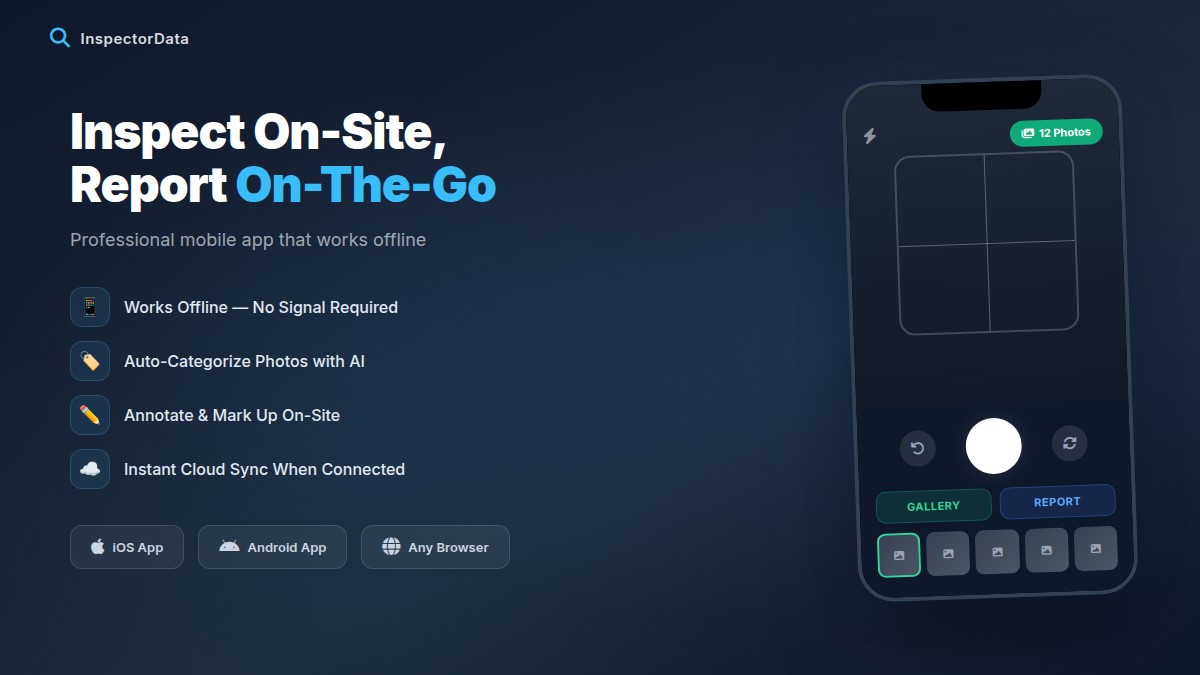
On-site, many inspectors talk into their phone rather than type. AI transcribes the voice note, then a second AI pass polishes the rough dictation into professional language. "Uh, water heater looks like it's maybe 15 years old, no expansion tank, TPR valve is corroded" becomes a clean, client-ready comment about the water heater's age, missing expansion tank, and corroded temperature-pressure relief valve. This workflow is built into platforms like InspectorData's mobile inspection app.
Scheduling Automation
AI-driven scheduling tools handle appointment booking, send automated confirmations, manage calendar conflicts, and even optimize drive routes between inspections. Clients book online 24/7, reducing phone tag and administrative overhead.
Report Formatting and PDF Generation
Once the inspection data is captured, AI formats everything into a professional PDF report with consistent structure, proper photo placement, and branded headers and footers. What used to be hours of post-inspection desk work now happens largely automatically.
What AI Cannot Do (And Won't Anytime Soon)
For all its capability, AI has hard limits that matter enormously in home inspection. These are not limitations that will be fixed with a software update next quarter. They are fundamental constraints rooted in what inspections actually require.
Physically Inspect a Property
A home inspection is a physical activity. You climb on roofs. You crawl through attics. You open electrical panels. You run water in every bathroom. You check every window, every outlet, every appliance. No AI system can do this. A camera drone can photograph a roof, but it cannot feel that the sheathing is soft underfoot or notice that a rafter is sagging only when you stand on it. Until robots can navigate a 1920s basement with a 5-foot ceiling, a human inspector is the only option.
Make Judgment Calls About Severity
AI can identify a crack in a foundation wall. It cannot tell you whether that crack is cosmetic settling that has been stable for 30 years or an active structural failure that warrants immediate engineering evaluation. That distinction requires experience, pattern recognition built over thousands of inspections, and the kind of contextual reasoning that current AI simply does not have. The inspector's judgment is the product clients are actually paying for.
Understand Local Building Codes Contextually
Building codes vary by state, county, and municipality. They change over time. A home built in 1978 is held to different standards than one built in 2024. AI can reference code databases, but understanding which code applies to which component in which jurisdiction at which point in time, and how local inspectors and code officials actually interpret those codes, requires localized human expertise.
Build Client Relationships
Home inspections are high-trust transactions. Buyers are spending hundreds of thousands of dollars on a property and relying on the inspector to tell them the truth. That trust is built through eye contact, tone of voice, the ability to answer follow-up questions on the spot, and the professional reputation the inspector carries. No chatbot replaces that.
Testify in Legal Proceedings
When an inspection finding becomes part of a legal dispute, someone needs to stand behind the report. That means a licensed, insured professional who can testify about what they observed, how they observed it, and what their professional opinion means. AI cannot be deposed. AI cannot carry errors and omissions insurance. AI is not a party to the transaction.
Detect Issues That Require Physical Testing
Moisture meters, radon detectors, thermal imaging cameras, gas leak detectors, carbon monoxide monitors: these tools require a trained human to operate, position, and interpret. AI can analyze a thermal image after it is captured, but it cannot decide where to point the camera or what anomaly warrants further investigation.
The Real Threat: Inspectors Who Don't Adapt
The question is not "will AI replace home inspectors?" The real question is: will inspectors who use AI replace the ones who don't?
The answer, based on what is already happening in 2026, is yes. Here is why.
Speed: 30 Minutes vs. 2+ Hours
An inspector using AI-assisted report writing finishes a standard single-family home report in roughly 30 minutes of desk time after leaving the property. Many complete the report entirely on-site before they drive away. An inspector writing comments manually, formatting photos by hand, and building PDFs from scratch spends 2 to 3 hours on the same report. Over the course of a year doing 300 inspections, that difference is 450 to 750 hours. That is 56 to 94 additional working days spent on report writing alone.
| Task | Manual Process | AI-Assisted Process |
|---|---|---|
| Photo categorization (200 photos) | 20-30 min | Automatic (0 min) |
| Writing comments (80 findings) | 60-90 min | 10-15 min (review only) |
| Report formatting and PDF | 20-30 min | 2-3 min (auto-generated) |
| On-site note-taking | Typed notes between rooms | Voice dictation with AI polish |
| Total post-inspection desk time | 2-3 hours | 20-30 minutes |
Quality: More Consistent, Fewer Errors
AI does not have bad days. It does not misspell "deterioration" or forget to mention the missing anti-tip bracket on a range. It generates comments using consistent professional language every time. The inspector still decides what goes in the report, but the writing quality stays high even on the third inspection of the day when fatigue normally sets in.
This consistency matters for liability. Reports with clear, professional language hold up better in disputes. Typos, incomplete sentences, and vague descriptions create ambiguity that lawyers exploit.
Cost: Lower Overhead Per Inspection
When report writing takes 30 minutes instead of 3 hours, inspectors can do more inspections per week or reclaim personal time. Either way, the effective cost per inspection drops. Some inspectors use the time savings to add ancillary services like sewer scopes, radon testing, or mold sampling, increasing revenue per appointment without adding hours to the day.
The math is straightforward. If AI tools cost $100/month and save you 2 hours per inspection, that is 40+ hours saved per month at 20 inspections. At any reasonable hourly rate, the return on investment is enormous.
How InspectorData Uses AI (Real Examples)
InspectorData is not theoretical about AI. Here is exactly what the platform does today:
AI Photo Analysis with Gemini Vision
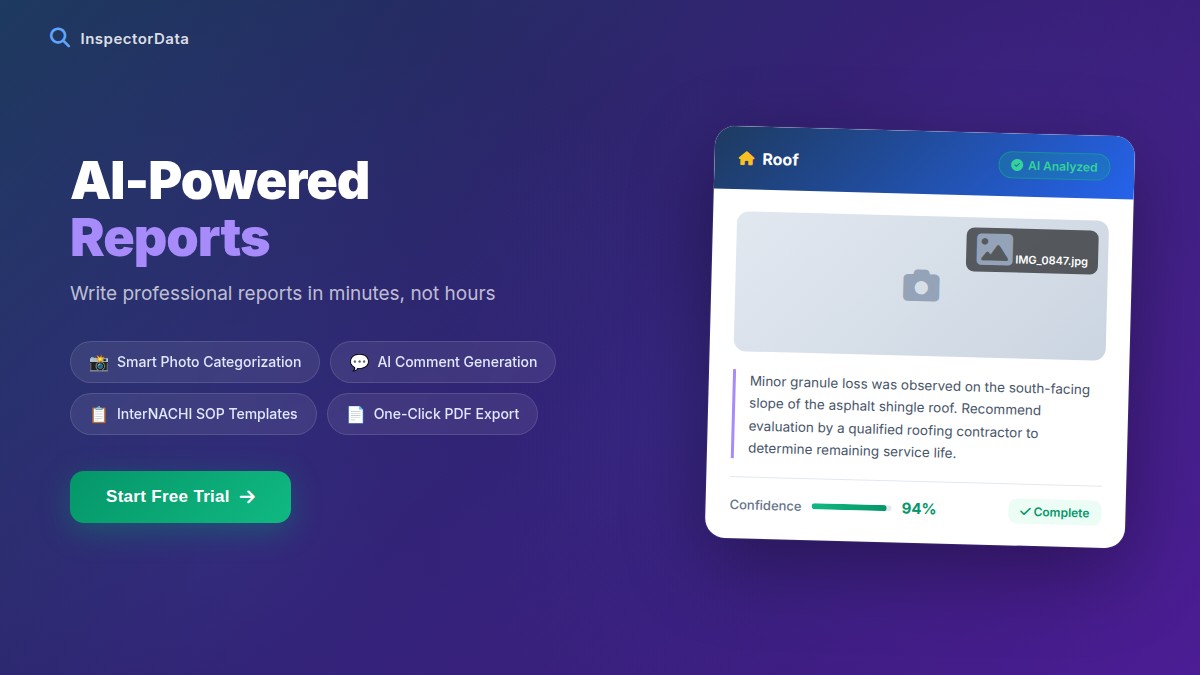
Every photo uploaded to an InspectorData report is analyzed by Google's Gemini Vision model. The AI identifies the building component, assesses the condition, and generates a confidence score. A photo of a rusted water heater is not just tagged "Plumbing" by the system. The AI identifies it as a tank-style water heater, notes visible corrosion at the base, and flags it for inspector review with a confidence rating.
Auto-Categorization into 15+ Building Systems
Photos are automatically sorted into categories like Roof, Exterior, Structure, Electrical, Plumbing, HVAC, Interior, Insulation, Fireplace, Garage, Kitchen, Bathroom, Attic, Crawlspace, and more. Inspectors using InspectorData's AI-powered reports skip the tedious dropdown-selection step entirely. The AI handles it, and the inspector corrects the rare miscategorization.
Comment Generation with Confidence Scores
For every photo, the AI generates a draft inspection comment. Each comment includes a confidence score from 0 to 100. High-confidence comments (85+) are typically accurate and need minimal editing. Lower-confidence comments are flagged for closer review. This system gives inspectors a clear signal about where to focus their attention rather than reviewing every comment equally.
Voice-to-Text with Auto-Polish
Inspectors dictate notes on-site using the InspectorData mobile app. The raw transcription is automatically polished by AI into professional inspection language. Rough voice notes become client-ready comments without the inspector touching a keyboard.
8,000+ Pre-Written Comment Library
When AI generation is not the right fit, inspectors can pull from a library of over 8,000 pre-written, standards-compliant inspection comments. The library is searchable by category, subcategory, and keyword, and comments can be inserted with one tap.
Frequently Asked Questions
Will home inspectors be obsolete?
No. Home inspections require physical presence, professional judgment, and legal accountability that AI cannot provide. AI is a tool that makes inspectors faster and more consistent, but it cannot replace the inspector on-site. The Bureau of Labor Statistics projects continued growth in construction and building inspection roles. As real estate transactions continue, so does the need for qualified inspectors who physically evaluate properties.
What AI tools do home inspectors use?
The most common AI tools in home inspection include photo analysis for defect identification, automated comment generation, voice-to-text transcription with AI polishing, report formatting and PDF generation, and scheduling automation. Platforms like InspectorData integrate all of these into a single workflow. Individual tools like speech-to-text apps and grammar checkers are also widely used, but integrated platforms offer the most significant time savings.
Is an AI-generated inspection report legal?
Yes, as long as a licensed inspector reviews, verifies, and signs the final document. AI generates draft comments and categorizes photos, but the inspector remains the licensed professional responsible for the report's accuracy and completeness. This is no different from using any software tool to write reports. The Standards of Practice still apply, the inspector's license is still on the line, and the E&O insurance still covers the inspector, not the software.
How much does AI inspection software cost?
AI-powered inspection software typically ranges from $49 to $199 per month depending on features and usage volume. InspectorData offers a 90-day free trial with full AI capabilities including photo analysis, comment generation, and report automation. Most inspectors find that the time savings from even basic AI features, roughly 1.5 to 2 hours per inspection, pays for the software with just one or two additional inspections per month.
See What AI-Assisted Inspections Actually Look Like
InspectorData gives you AI photo analysis, auto-categorization, comment generation, voice-to-text with auto-polish, and a library of 8,000+ pre-written comments. Try everything free for 90 days and see why inspectors using AI are finishing reports before they leave the property.
Try InspectorData Free for 90 DaysNo credit card required. Set up in 10 minutes.